
Intentional Creativity: Rethinking Unlimited Choice

Many educators believe that creativity is best supported by providing children open-ended materials and freedom to explore and create with them however they choose. But what if I told you that true creativity actually thrives not in unlimited freedom, but within thoughtfully designed boundaries?
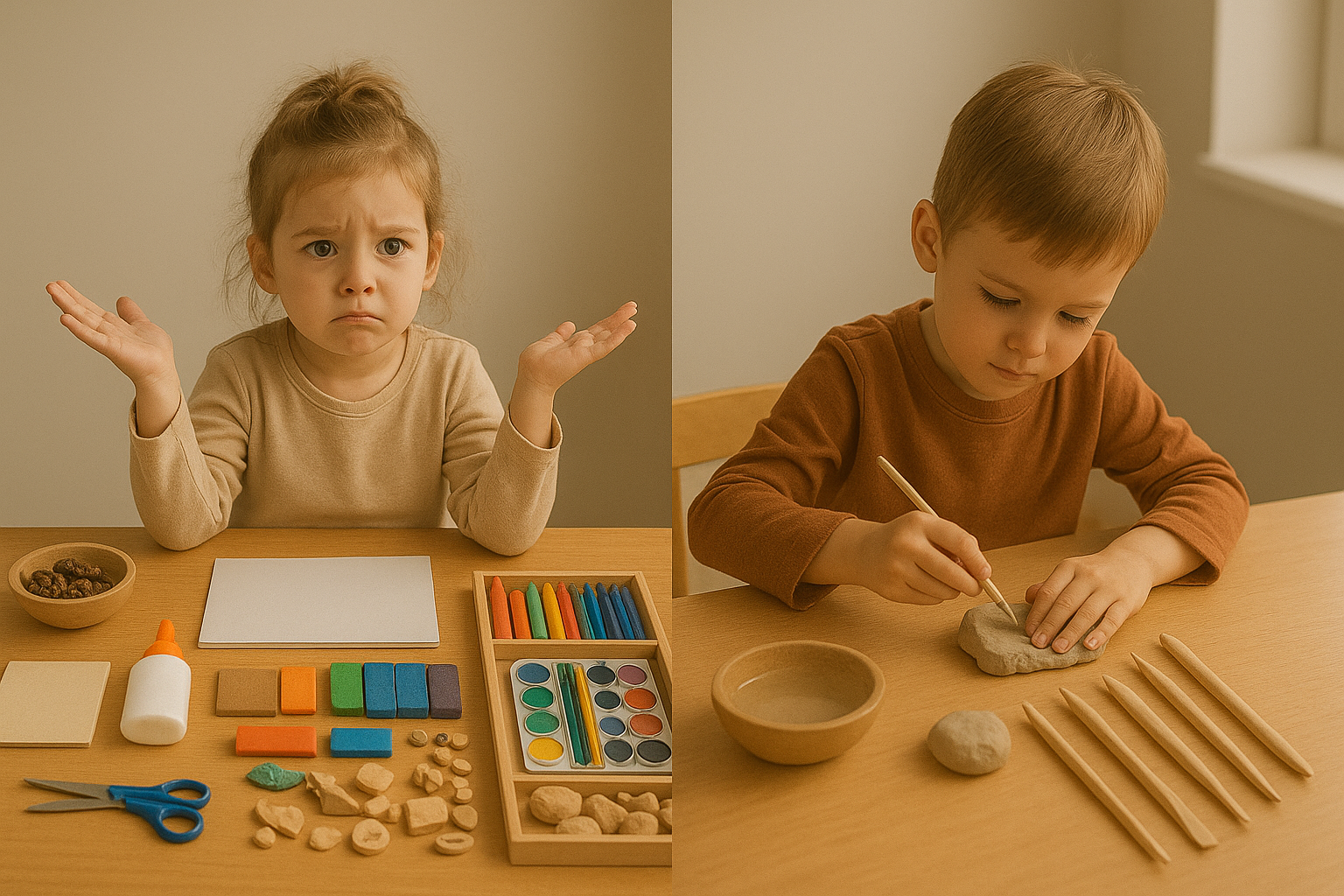
Picture this: a classroom overflowing with every art material imaginable, children wandering from station to station, creating whatever strikes their fancy in the moment. While this scene might look wonderfully child-centered, it often leaves children overwhelmed and without the foundational skills they need to truly express their ideas.
Let’s rethink unlimited choice and endless material consumption and move beyond the laissez-faire approach to embrace a more nuanced understanding of how children develop creative confidence and skill.
Here's a counterintuitive truth: creativity thrives not in an expanse of unlimited possibility, but within the boundaries of constraint. When we impose thoughtful limitations, we force children (and ourselves) to think differently, to innovate, and to focus (Kiernan, 2024). This concept mirrors Maria Montessori's principle of "freedom within limits"—the idea that children flourish when they have clear boundaries within which to explore and create. When children know what materials are available and understand the possibilities each material holds, they're empowered to make intentional choices rather than random selections.
Rather than unlimited choice leading to unlimited creativity, Reggio inspired education emphasizes negotiated learning—a careful dance between children's interests and educator guidance. This isn't about controlling the creative process, but about intentionally selecting or curating materials and facilitating skill development that honors both beauty and sustainability.
As Carlina Rinaldi (2006) emphasizes, educators serve as keen observers who document children's learning journeys and offer gentle guidance, rather than controlling how creativity unfolds. In Reggio Emilia, this guidance includes the crucial work of the atelierista (resident artist), who teaches specific skills in the atelier (art studio), giving children the tools they need to bring their visions to life.
But wait, doesn't teaching specific skills stifle creativity? Actually, the opposite is true. When children lack the technical knowledge to manipulate materials effectively, their "free expression" becomes frustratingly limited. They may have brilliant ideas but lack the skills to execute them, leading to disappointment rather than creative fulfillment. Guidance and focused exploration time allow children (and educators) to learn the language of each material—discovering its affordances, abilities, and actions that form its creative alphabet of possibilities
If we want children to feel the freedom to experiment, take risks, and learn from mistakes and have the confidence that comes from competence, they need access to the skills that allow them to create in intentional and meaningful ways. Without these skills, free expression actually puts them at a disadvantage, limiting rather than expanding their creative possibilities.
This doesn't mean we need rigid, step-by-step instructions that produce cookie-cutter crafts. Instead, we must find that sweet spot—the in-between space where children's ideas and voices are honored while they're simultaneously building the technical foundation they need to express those ideas effectively. While we rightly value process over product in early childhood education, we shouldn't dismiss the importance of helping children develop the persistence needed to create more polished work. In our fast-paced world, where attention spans seem to be shrinking, there's real value in supporting children through the sometimes challenging work of refining their creations.
As Isbell and Raines (2013) emphasize, "supportive environments help children maintain and express creativity rather than suppressing it to conform." A truly supportive environment provides both the freedom to explore and the scaffolding to develop mastery. Instead of providing a smorgasbord of materials and total freedom, let’s be more intentional in our selection of materials and purposeful in our guidance. When we provide children with both the technical foundation and the creative space to explore, we're not limiting their creativity—we're amplifying it.
The goal isn't to control what children create, but to ensure they have the tools they need to create with intention, confidence, and joy. In this balanced approach, constraint becomes not a limitation, but a launching pad for authentic creative expression.
What does intentional creative education look like in your setting?
How might you balance freedom and skill-building in your approach to children's creative development?
References
Isbell, R. T., & Raines, S. C. (2013). Creativity and the arts with young children (3rd ed.). Wadsworth Cengage Learning.
Kiernan, P. (2024, December 16). The creativity of constraint: Why limits spark innovation. ThoughtLab. https://www.thoughtlab.com/blog/the-creativity-of-constraint-why-limits-spark-inno/
Rinaldi, C. (2006). In dialogue with Reggio Emilia: Listening, researching, and learning. London: Routledge.
*Images generated by ChatGPT & article edited with Claude AI. However, all suggestions were critically evaluated and final decisions were made independently by the author to ensure that AI functioned as a support tool and critical friend while maintaining academic integrity and originality.